The Paradox of Modern Engineering:
We are witnessing a historical anomaly: a technology that makes seniors superhuman while making juniors unemployable.
Two recent pieces crystallized this paradox in very different ways.
One argument says the classic online developer community — the place where juniors asked questions, seniors gave tough-love answers, people learned by reading other people’s mistakes — is quietly dying. Not because people stopped coding, but because the incentive structure changed. When you can get a decent-enough answer in 15 seconds from a large language model, why spend 20 minutes writing a question, waiting for replies, and then defending your code style?
The other argument is more brutal: the junior developer role itself is disappearing as a viable entry point into the profession. The repetitive, pattern-based, “first 3–5 years of grinding” work — writing CRUD endpoints, unit tests, basic data transformations, simple UI wiring, validation logic — is now the exact kind of work that current AI coding assistants do passably well (and getting dramatically better every 6–12 months).
Put both observations together and you get a worrying picture:
- The traditional learning flywheel (do boring work → make mistakes → read other people’s mistakes → ask questions → get feedback → slowly get better) is breaking.
- At the same time, companies are discovering they need far fewer people to ship the same (or more) features — as long as those people are already strong.
The 2024–2026 Reality Check
- Entry-level software engineering hiring at major tech companies dropped roughly 25–40% between 2022–2024 even before the deepest AI coding impact hit (source: SignalFire State of Talent Report 2024 & 2025 editions)
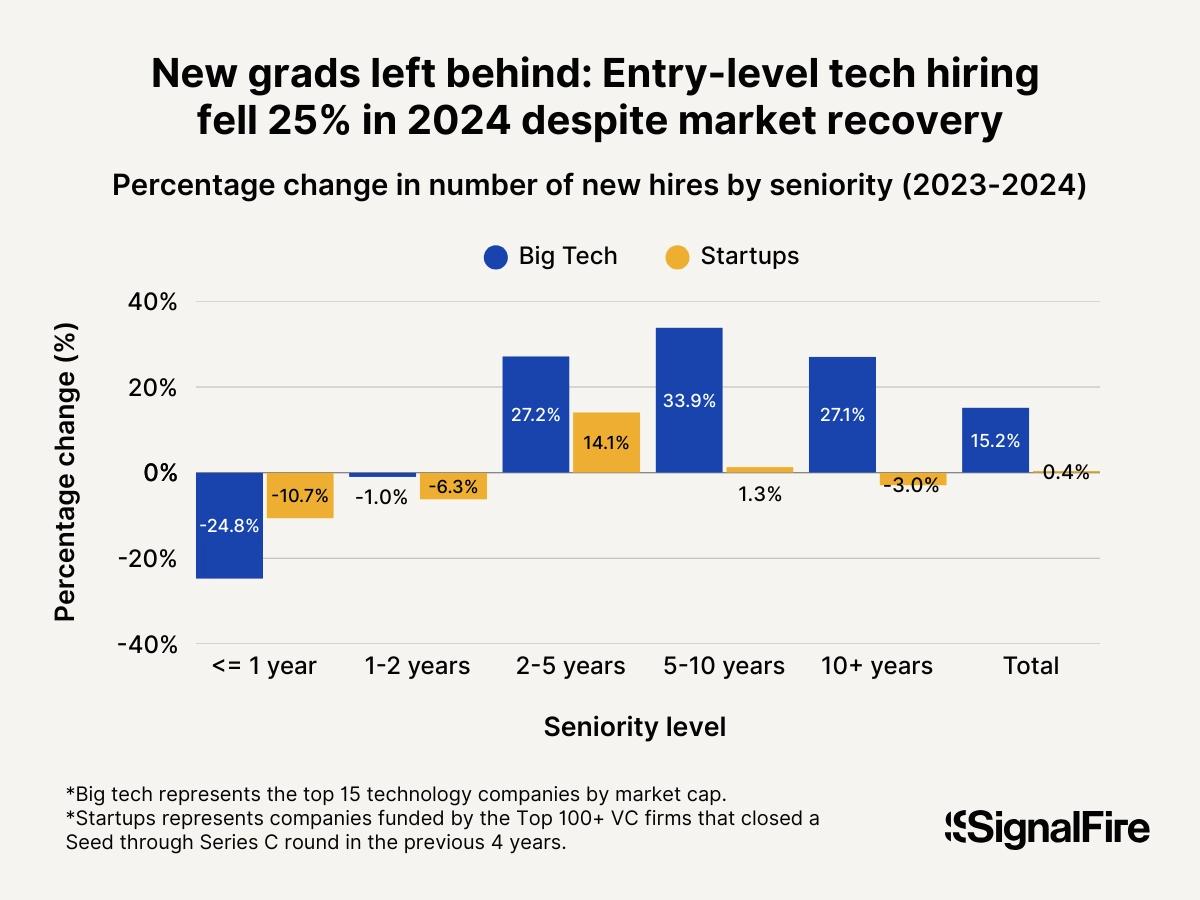
Image source: SignalFire
- US computer science graduates in 2024–2025 faced unemployment rates significantly higher than the overall recent graduate average — some reports put new CS grads at 6–8% unemployment vs ~4% for all majors (source: Federal Reserve Bank of New York, Burning Glass / Lightcast data)
- Companies that adopted GitHub Copilot or similar tools early reported 30–55% faster task completion on well-defined tickets — but almost no productivity gain (sometimes even slowdown) when seniors had to review and fix AI-generated code on complex, legacy, or high-stakes codebases (GitHub internal studies, METR / METR.org early 2025 evaluations)
- Percentage of code written by AI in production repositories crossed 40–50% in many well-instrumented large teams by late 2025 (source: GitClear 2025 State of Code Quality report, multiple enterprise anecdotes)
The emerging shape of the 2028–2032 developer workforce
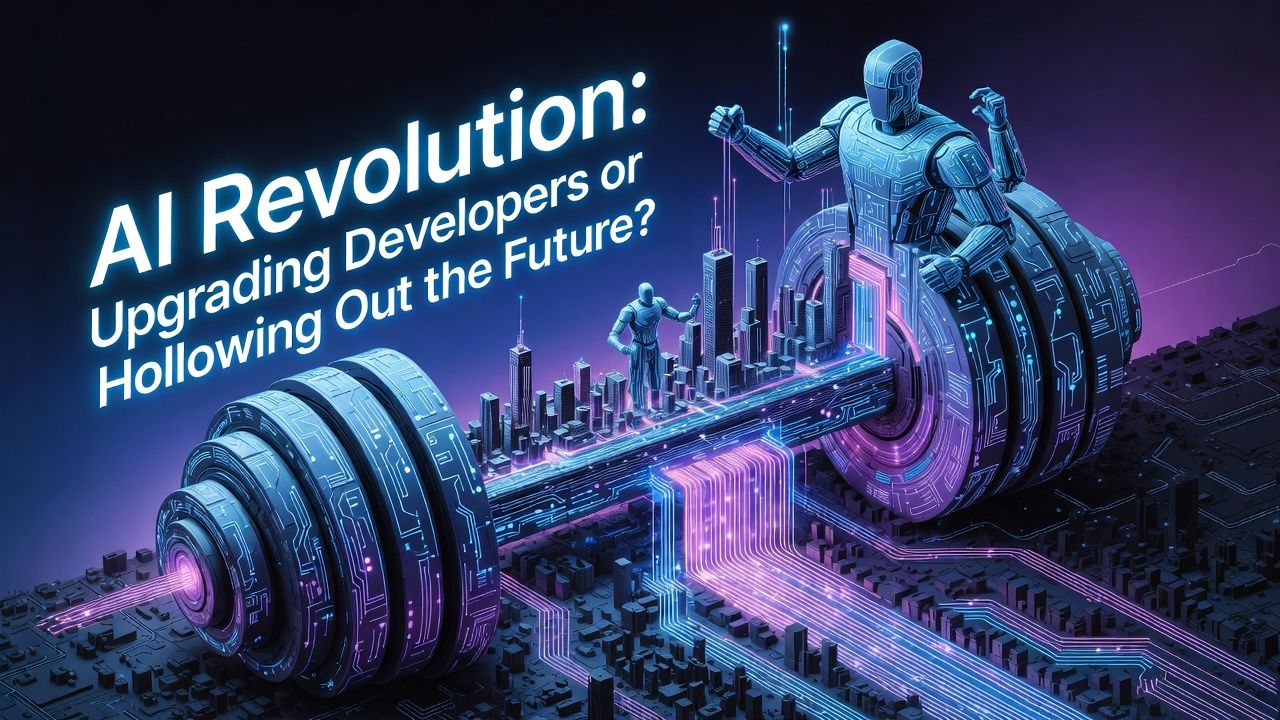
We are likely moving toward a barbell-shaped profession:
- Top ~20–30%: “super-senior” engineers / AI conductors / system architects → extremely productive, manage multiple AI agents, review high-leverage decisions, own reliability/security/performance → earn significantly more than today (demand stays high)
- Middle 40–50%: solid mid-level engineers who survived the transition → mostly doing review, refactoring, testing strategy, integration, keeping AI output from rotting the codebase → narrower career growth compared to previous decades
- Bottom 20–40%: very hard to enter and stay → almost no “learn on the job” junior roles → mostly self-taught people who already built real products before applying.
The scariest outcome is not mass unemployment of existing developers. The scariest outcome is hollowing out of the middle and bottom — creating a profession with almost no on-ramp, very few ways to go from “can make things work” to “can be trusted with production systems”.
What probably comes next
- Code quality bifurcation Teams with strong review culture → cleaner, more maintainable code even with 60%+ AI authorship Teams without discipline → lots of duplicated logic, subtle bugs, increasing technical debt velocity
- New bottleneck moves upward The limiting factor stops being “writing code” and becomes:
- understanding the domain deeply
- designing systems that don’t explode when requirements change
- catching the 5–15% of AI suggestions that are confidently wrong but subtle
- reasoning about security, observability, cost, latency at scale
- Education & bootcamps must change — fast Syntax & CRUD mills are already obsolete. Future effective training will need to focus much more on:
- reading & critiquing AI-generated code
- writing good prompts & agent instructions
- forensic debugging (why did this LLM suggestion break in production?)
- system design under uncertainty
- testing strategy in an AI-heavy world
- The “AI-native senior” premium will be huge People who can 3×–10× their output via AI while keeping quality high are going to be absurdly valuable for the next 8–12 years.
Conclusion
AI Isn’t Ending Developer Careers — It’s Upgrading the Entire Profession. It is killing the slow, safe, 8–12 year career ladder that most of us climbed.
Now the path looks more like:
- Either become very good, very fast → or get stuck at the bottom with diminishing opportunities.
- Either learn how to make AI multiply your judgment → or become someone whose judgment is replaced by AI.
The window to adapt is not forever.
Most of the people who will thrive in 2030 are already adapting in 2026.