Why MERN?
The combination of MongoDB, Express, React, and Node.js provides a unified JavaScript environment that speeds up development cycles significantly. In the 2026 landscape, where speed-to-market is the primary competitive advantage, MERN stands out by eliminating the "context switching" tax. Developers can move from writing database queries to frontend hooks without ever leaving the JavaScript ecosystem.
Beyond the Basics: The Rise of the "T-MERN" Stack
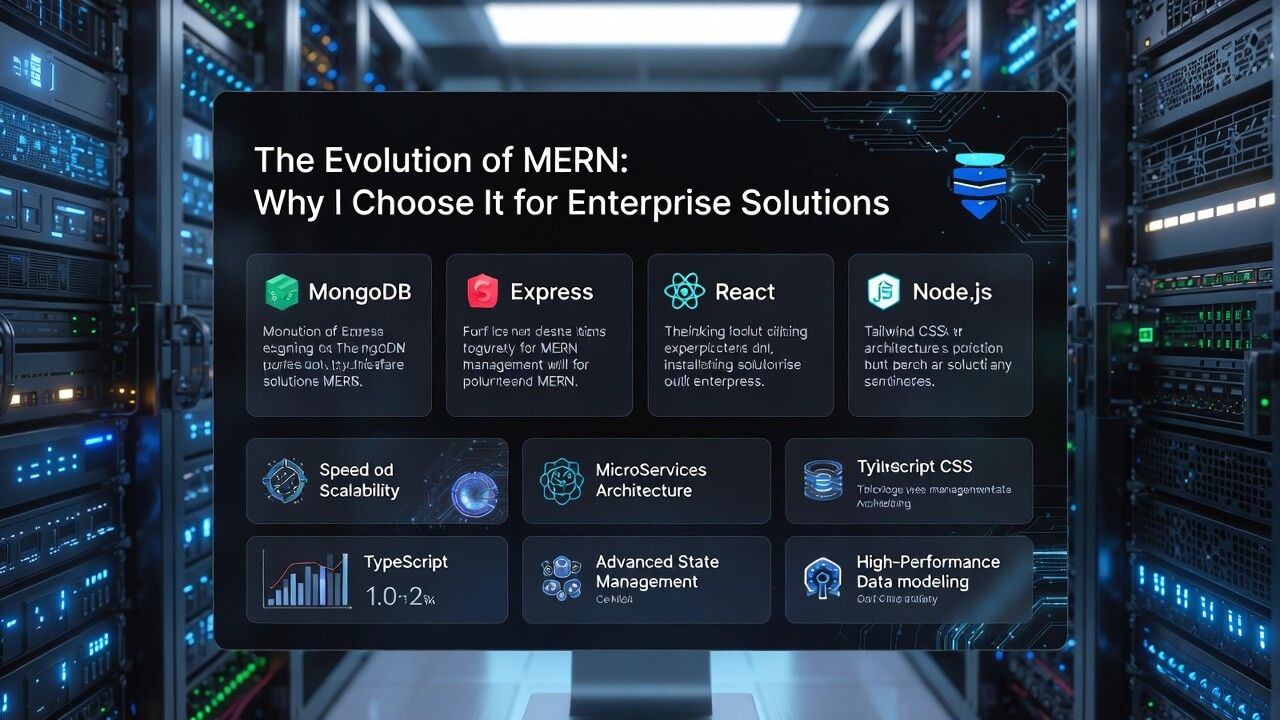
In my recent projects, I've started augmenting the standard MERN stack with TypeScript for type safety and Tailwind CSS for rapid UI development. This "T-MERN" approach has reduced our bug count by nearly 25% and slashed our CSS bundle sizes by half.
For enterprise-grade software, these additions aren't just "nice-to-haves"—they are essential for maintaining a clean, scalable codebase that can survive years of feature iterations.
Scaling MERN for the Modern Enterprise
Many skeptics argue that MERN is "only for startups." My experience suggests otherwise. When architected correctly, MERN is a powerhouse for large-scale systems. To achieve enterprise reliability, we focus on three core pillars:
1. Microservices and Modular Architecture
Instead of a monolithic Node.js server, we break complex business logic into independent services. This allows teams to scale specific parts of the application—like payment processing or real-time notifications—independently.
2. Advanced State Management
For enterprise data, useState isn't enough. We leverage TanStack Query (React Query) for server-side state and Zustand or Redux Toolkit for global client state. This ensures that data remains consistent across complex dashboards and multi-step workflows.
3. High-Performance Data Modeling
Enterprise MongoDB isn't just about storing JSON. We implement Horizontal Sharding and Aggregation Pipelines to handle millions of records. Combined with Redis caching, this ensures sub-second response times even under heavy loads.
MERN vs. The Competition (MEAN, Java, .NET)
While Java and .NET have long been the "safe" enterprise choices, MERN is winning in 2026 for several reasons:
- Talent Density: JavaScript is the most popular language globally, making it easier to hire and onboard top-tier talent.
- Shared Logic: You can share validation logic (via Zod or Joi) between the frontend and backend, ensuring your data is clean before it ever hits the database.
- Total Cost of Ownership (TCO): With shared tooling and faster dev cycles, MERN projects typically see a 30-40% cost reduction compared to polyglot architectures.
| Feature | MERN (T-MERN) | Legacy (Java/.NET) |
| Development Speed | Ultra-Fast | Moderate |
| Community Support | Massive / Modern | Established / Legacy |
| Language Consistency | Unified (JS/TS) | Multi-language |
| Scalability | High (Horizontal) | High (Vertical/Horizontal) |
The Verdict: Is MERN Future-Proof?
As we move further into the era of AI-integrated applications, the MERN stack's flexibility is its greatest asset. Node.js is becoming the go-to runtime for AI orchestration, and React remains the gold standard for building the complex, interactive UIs that AI tools require.